Monday, January 19, 2015

Black and White United in Friendship


Daryl Davis is no ordinary musician. He’s played with President Clinton and tours the country playing “burnin’ boogie woogie piano” and sharing musical stylings inspired by greats like Fats Domino, Chuck Berry and Jerry Lee Lewis. He’s a highly respected and electrifying performer who is currently an integral member of The Legendary Blues Band (formerly known as the Muddy Waters Band,) and he rocks the stage all over the nation.
Davis’ travels, of course, have always afforded him the opportunity to meet a huge range of diverse people, but perhaps nothing could have prepared him for the moment that would change his life.


It was 1983 and Davis was playing country western music in an (informally) all-white lounge. He was the only black musician in the place and when his set was over, a man approached him. 

“He came up to me and said he liked my piano playing,” says Davis, “then he told me this was the first time he heard a black man play as well as Jerry Lee Lewis.” Davis, somewhat amused, explained to the man: “Jerry Lee learned to play from black blues and boogie woogie piano players and he’s a friend of mine. He told me himself where he learned to play.” At first, Davis says, the man was skeptical that Jerry Lee Lewis had been schooled by black musicians, but Davis went on to explain in more detail. “He was fascinated,” says Davis, “but he didn’t believe me. Then, he told me he was a Klansman.”

Most people in this day and age probably would have turned and ran right out of that good ol’ boy’s bar, but not Davis. He stayed and talked with the Klansman for a long time. “At first, I thought ‘why the hell am I sitting with him?’ but we struck up a friendship and it was music that brought us together,” he says.
That friendship would lead Davis on a path almost unimaginable to most folks. Today, Davis is not only a musician, he is a person who befriends KKK members and, as a result, collects the robes and hoods of Klansmen who choose to leave the organization because of their friendship with him.

 
The road to these close and authentic friendships, Davis says, involved a lot of learning on his part. He’d had racist experiences and had long wanted to write a book about race relations, but hadn’t had the opportunity to sit down and talk to a Klansman. His upbringing was extremely diverse, and his first experience with organized racism was a shock. He explains:
I was raised overseas in integrated schools. I had had a racist experience already but I didn’t know people organized into groups whose premise was to be racist and exclude other people. It seemed unfathomable to me. My parents were in the Foreign Service and I was an American embassy brat, going to international schools overseas. My classes were filled with anyone who had an embassy: Japanese, German, French, Italian. It was multicultural but that term did not exist at that time. For me it was just the norm. Every time I would come back (to the US,) I would see people separated by race. When my father was telling me about (the KKK) at the age of 10 it didn’t make any sense to me. I had always gotten along with everyone.
When Davis decided he needed to write a book about the KKK, he knew he had to find the friend he’d made in the country western bar. Davis tracked him down eight years after they had first met. “I went to his apartment unannounced,” Davis says. “He opens the door and sees me, and he says ‘Daryl! What are you doing here?’ He stepped out of his apartment and I stepped in. He said ‘what’s going on man? Are you still playing?’ I said ‘I need to talk to you about the Klan.'”


At first, his friend resisted, saying he would not give Davis the information he was seeking. “He would not do it because he was fearful,” Davis says. “He thought I would be killed. I said ‘well give me the guy’s number and address.’ He finally gave me Roger Kelly’s number and address but he told me: ‘don’t go to his house; meet him in a public place.'” Davis immediately began making plans to approach Kelly, who at the time was the leader of the KKK in Maryland.


“My secretary called him,” Davis says, “and I told her, ‘do not tell Roger Kelly I’m black. Just tell him I am writing a book on the Klan.’ I wanted her to call because she’s white. I knew enough about the mentality of the Klan that they would never think a white woman would work for a black man. She called him and he didn’t ask what color I was, so we arranged to meet at a motel.”

That meeting, says Davis, was fraught with tension from the start. Kelly arrived at the motel with a nighthawk-a bodyguard dressed in military style fatigues-complete with a firearm.

We met at a motel, and I sent my secretary down the hall to get an ice bucket and sodas so I could offer Mr. Kelly a beverage. The room, by coincidence, was set up so that if the door opened, you could not see who was inside…Right on time there’s a knock on the door. A bodyguard dressed in military gear comes in with a KKK beret and a gun on his hip. Mr. Kelly is directly behind him in a dark blue suit. The bodyguard comes in and sees me and freezes in his tracks. Mr. Kelly trips and slams into him like they were dominoes.

I saw the apprehension so I got up and walked over and said ‘Hi Mr. Kelly, come on in.’ He shook my hand, the bodyguard shook my hand, and they came in. Mr. Kelly sits down and the bodyguard stands at his right. He asked for identification and I handed him my drivers’ license. He says ‘oh you live on Flack Street in Silver Spring.’ Well, I didn’t need him coming to my house and burning a cross or whatever, and here he is calling off my street address. I wanted to let him know not to come to my house so I said ‘yes, and you live at…’ and I said his street address. I made it clear-‘let’s confine our visit to this hotel room.’
But I had no reason to be concerned. One of his Klan members lived right down the street from me. It was coincidence.
The tension, however, continued, Davis says, and eventually reached a fever pitch.
Every time my cassette would run out of tape, I would reach down into my bag and pull out another. Every time I reached down, the bodyguard would reach for his gun. He didn’t know what was in the bag. After a while he relaxed and realized nothing was in the bag but cassettes and the bible. After about an hour, there was a very loud, strange noise which was ominous, and I was apprehensive. In the back of my mind, I heard my friend in my head saying ‘Mr. Kelly will kill you.’ I stood up and slammed my hands on the table, and I felt my life was in danger. When my hands hit the table, my eyes locked with his, and he could read them. We stared into each other’s eyes. The bodyguard was looking back and forth at us, but then my secretary Mary realized what had happened.


The ice bucket had melted and the cans of soda shifted, and that’s what made the noise! We all began laughing at how stupid we all had been. In retrospect, it was a very important lesson that was taught. All because a foreign entity of which we were ignorant, entered into our comfort zone, we became fearful of each other. The lesson learned is: ignorance breeds fear. If you don’t keep that fear in check, that fear will breed hatred. If you don’t keep hatred in check it will breed destruction.

After that defining moment, the meeting was much more relaxed. Davis became friends with Kelly and eventually went on to befriend over 20 members of the KKK. He has collected at least that many robes and hoods, which he has hanging in his closet. He also is viewed as being responsible for dismantling the entire KKK in Maryland because things “fell apart” after he began making inroads with its members there.

He says that KKK members have many misconceptions about black people, which stem mostly from intense brainwashing in the home. When the Klansmen get to know him, he says, it becomes impossible for them to hold on to their prejudices. He explains:

This Klansman and I were riding around in my car and the topic of crime came up. He made the remark that all black people had a gene that makes us violent. I said ‘Gary, what are you talking about?’ He said ‘Who’s doing all the shootings?’ I said ‘let me tell you something, I am as black as anyone you’ve ever seen and I’ve never done a drive by or a shooting.’ After a time I said ‘you know, it’s a fact that all white people have within them a gene that makes them serial killers. Name me three black serial killers.’ He could not do it. I said ‘you have the gene. It’s just latent.’ He said ‘well that’s stupid’ I said ‘it’s just as stupid as what you said to me.’ He was very quiet after that and I know it was sinking in.
Davis also became close with Robert White, a Grand Dragon in the KKK. “I respect someone’s right to air their views whether they are wrong or right,” Davis says. “Robert White was a Grand Dragon who had gone to prison numerous times. I said I wanted to interview him for my book. At first, he was very violent and very hateful but we talked for a long time. Over time, he began thinking about a lot of things he had done and said that were wrong. He quit the Klan. Toward the end he said he would follow me to hell and back. …and he gave me his robe and hood, and his police uniform.”
 

Davis recounts his experiences with the KKK in his book Klan-Destine Relationships. He says his friendships are real and intimate, and that he does typical things with his friends who are in the Klan. He has even served as a pallbearer at a Klansman’s funeral and attended another’s wedding. When asked about the fear many people feel when confronted with images of KKK members, he says “It’s just material. You have to address what’s in the person head and in their heart.”


Indeed, Davis says that the best way to break down barriers and improve race relations is for two people who disagree with each other to sit down and talk:

A lot of people have anti-racist groups. They get together and meet and have a diverse group and all they do and sit around and talk about how bad discrimination is. Then someone says ‘there’s a Klan group across town. Why don’t we invite them to come and talk to us?’ and the other person says ‘Oh no! We don’t want that guy here!’ Well, you’re doing the exact same thing they are. What’s the purpose of meeting with each other when we already agree? Find someone who disagrees and invite them to your table.

Invite your enemy to talk. Give them a platform to talk because then they will reciprocate. Invite your enemies to sit down and join you. You never know; some small thing you say might give them food for thought, and you will learn from them. Establish dialogue. It’s when the talking stops that the ground becomes fertile for fighting.

Davis currently keeps busy by playing in his band and touring the country giving lectures. He is planning a second follow-up book to Klan-Destine Relationships. He says there’s no need to be afraid of the KKK because at least they make their intentions clear, whereas racism can manifest in anyone, and it is often invisible. He urges those who wish to combat racism to reach out to those who have misconceptions about race.
“When two enemies are talking,” he says, “they’re not fighting.”


Link: http://guardianlv.com/2013/11/kkk-member-walks-up-to-black-musician-in-bar-but-its-not-a-joke-and-what-happens-next-will-astound-you/

Sunday, January 18, 2015

Don't TRUST the Mainstream Media

“I wasn’t going to send this email to FYM, but, the feeding frenzy on Bill Cosby’s character made my response necessary. In 1982, I had a photographer named Choice. Choice was contacted by a casting agent, I was told to meet the client at the Ritz Carlton for lunch in New York in the summer of 82’. This client wanted to talk to me about a film project. I arrived at the Ritz Carlton at 11:30 AM. Two male clients arrived; a Caucasian male (late 30s) and an Asian male (early 50s). They indicated that I’d be perfect for a film project.

I was told the project paid $5000 cash. I thought that was strange, who pays $5000 cash for a modeling job? The job was to meet Bill Cosby and to try to seduce him; it would be apart of the script. I was confused by this job request? They told me I would be recording the session to see if I was successful and believable? 

My response to them… I would like to meet Mr. Cosby first and discuss the script. They said no, it wasn’t necessary to meet him. They said it was a spontaneous casting call? I have never in my life heard of a spontaneous casting call.


As a legitimate model this seemed strange and unethical. I immediately turned down the job. The Asian man continued speaking and offered me $10,000 cash upfront and $5000 upon delivery of some seductive photos and some of his sperm. Sperm?
(I was in shock when they said sperm?) I then realized that these two men had unethical intentions. I excused myself, went to the bathroom, and then I left the hotel and went home. 


 Now, as a model in New York, I’ve been offered drugs, trips around the world, films, videos, money from rich men, casting couch and the list is endless.


As a naive model you’re offered many compromising projects, but, this blew my mind. I was offered $15,000 to seduce and destroy Bill Cosby. Why else would they need suggestive photos and sperm? I also realized that America has a history of oppressing, killing and destroying successful and poor people of color.


I wasn’t going to send this letter to FYM, but, the media lynching of one of our global icons (Bill Cosby), is simply
other news outlets blatantly misconstrue and lied about old dismissed allegations of Bill Cosby. I’m shocked by the lack of integrity of our major news media. Why would CNN, ABC, CBS, AP and the like lie about 30 year old untrue news? 


Nightline simply cut, deleted and distorted the Cosby interview– making him appear guilty. What has happened to the integrity of our nation?

I was offered $15,000 cash to discredit and ruin Bill Cosby’s good name. I’m 100% convinced that all the women coming forward have been paid off to discredit Bill Cosby as well. Why? He is simply too powerful, his intentions is to empower people of color and his net worth would anger any weak man.  

If you remember it was durinh his time as the top TV talent that Bill cosby tried to buy NBC....


From The New York times:
http://www.nytimes.com/1992/10/29/business/the-media-business-bill-cosby-trying-to-buy-nbc-from-ge.html 


Bill Cosby, NBC's biggest star of the 80's, is trying to buy the television network from its current owner, the General Electric Company. 


Norman Brokaw, the chief executive of the William Morris Agency and Mr. Cosby's personal agent for 30 years, confirmed yesterday that he had discussed Mr. Cosby's intention to make an offer for NBC with Robert C. Wright, the network's president.

Mr. Brokaw said he flew into New York last week expressly to meet with Mr. Wright. "I told him Bill is definitely interested in buying NBC, and Mr. Wright eventually said that NBC is not for sale." 


For more than two years, NBC has been the subject of continuing rumors that it is for sale, especially since its ratings have gone into a steep decline. 


Mr. Brokaw said he and Mr. Cosby had decided "to fully pursue a deal" for NBC. He added that Mr. Cosby had met with his lawyer, Herbert H. Chaice, to discuss the details of the possible purchase.

Mr. Chaice, of the Manhattan firm of Patterson, Belknap, Webb & Tyler, said he had talked with investment houses about Mr. Cosby's becoming what he called "one of a number of principals" in such a purchase. "It's not likely that Bill will do the whole thing, nor would I consider it prudent that he try to," Mr. Chaice said.

Mr. Brokaw said Mr. Cosby had held preliminary talks with "a couple of individuals" on being partners in an NBC takeover.

Neither Mr. Brokaw nor Mr. Chaice disclosed how much Mr. Cosby might be willing to pay for NBC. 


But analysts said the asking price for NBC was likely to be about $4 billion. General Electric paid $6.5 billion when it acquired the network's parent company, the RCA Corporation, in 1986. General Electric has since sold off RCA's electronics divisions and acquired several other television properties, including the cable channel CNBC. 

It was also during this time that Bill Cosby's son was mysteriously murdered on the side of the road. Was his son's murder a message to remind Bill Cosby that TPTB don't like him meddling in their business affairs? 


I personally find it ODD that it took 30 years for this info to surface.  The other question is why now?  Why not while he was at the top of the TV networks?  There would have been a greater financial pay day if the accursers wished to bring a civil case against Bill Cosby.  Why wait till their is nothing to be gained from this information other then the character assassination of Bill Cosby's image? 

To be certain, Bill Cosby is one of the few Black men in America who speak openly and honestly.  He often speaks about the real reason Blacks are 2nd class citizens here in America.  It's not because the white man is holding them down, but because Blacks have bought into the whole baby mama's, absent fathers, and welfare queens ruling the black family formula.  

TPTB don't want an honest, hard working, Black man speaking the truth and disrupting their plans to keep the Black community enslaved vis a vie the Welfare-Free government money system.

Wednesday, January 14, 2015

Open Letter to Eric Holder, Attorney General and Race Baiter

Former FBI Special Agent K. Dee McCown wrote an open letter to Eric Holder. The response has been epic.

Here is the letter:


K. Dee McCown
College Station, Texas
December 28, 2014

Attorney General Eric Holder
U.S. Department of Justice
950 Pennsylvania Avenue, NW
Washington, DC 20530-0001 


Dear Attorney General Holder:

It is unlikely that we met while I served in the FBI. That being said, we served at the Department of Justice (DOJ) during the same years and on the same “team” conceptually speaking. During my service in the FBI I worked with a number of U.S. Attorney Offices in the United States to include a tour at FBIHQ where I worked with the Department of Justice (Main) on a daily basis.

I begin my letter with this comment to highlight that I am not a bystander on the topic of law enforcement in the United States. I worked and managed a variety of federal investigations during my 12 years of service in the FBI, to include the management of several Civil Rights cases in the State of Texas. In fact, during my last tour in the Bureau, I was an FBI Supervisor responsible for managing federal investigations in nine (9) Texas counties, many of which were rural; in places where one would suspect racism to flourish given the narrative often pushed by Hollywood and urban progressive elites like yourself.


 I performed this mission diligently and under the close supervision of two FBI managers; an Assistant Special Agent in Charge (ASAC) and Special Agent in Charge (SAC,) both of which happened to be African American and outstanding law enforcement professionals. I also performed this mission serving side by side with a variety of law enforcement agencies at the Federal, State and local level.


I have observed you closely during your tenure as Attorney General and notably during these last tumultuous years; watching you negotiate a number of controversial public matters to include the ATF Fast and Furious scandal, Black Panther Party intimidation at voting booths, IRS targeting of American citizens (citizen groups opposed to the Obama Administration,) the ignoring of US Immigration laws, DOJ criminal indictments of select news reporters and your management of several high profile criminal investigations involving subjects of race, notably African Americans.


Until today, I chose to hold my tongue. However, with the assassination of two NYPD Lieutenants last weekend in New York City, at the hands of a African American man with a lengthy criminal record, fresh from his participation in anti-police activities; coupled with numerous “don’t shoot, hands up,” and “black lives matter” anti-police protests (some of which are violent) occurring daily around the nation, I am compelled to write you this letter.


To be blunt Mr. Holder, I am appalled at your lack of leadership as the Attorney General of the United States and your blatant politicizing of the Department of Justice. Your actions, both publicly and privately, have done nothing to quell the complex racial issues we face in our country and have done everything to inflame them. As the “top cop” of the United States, you share in the blame for much of the violence and protests we are now witnessing against law enforcement officers honorably serving throughout our nation.
 

During one of your first public speeches as Attorney General you made it a point to call America “a nation of cowards” concerning race relations. That speech, followed by other public announcements where you emphatically opined that the odds were stacked against African Americans in regard to the enforcement of law, your intention to change the law and permit convicted felons to vote after 
incarceration, and your changes to federal law ending “racial profiling,” are poignant examples of how detached you remain from the challenges faced by law enforcement officers serving in crime ridden neighborhoods throughout the nation. These opinions are also indicative of a man that lives and works in the elitist “bubble” of Washington D.C.


Your performance, as the nation’s Attorney General, during the Trayvon Martin case in Sanford, Florida and the Michael Brown case in Ferguson, Missouri clearly highlights your myopic view on this topic. Contrary to your embarrassing prejudgment in the Brown case and evasive post trial remarks on the Martin case, neither Brown nor Martin were targeted and/or killed because of their African American race. Rather, as non-emotive investigations determined, both teens died as a consequence of their own tragic and egregious behavior; behavior that involved a violent assault on a law abiding citizen in the Trayvon Martin case, and a violent assault on a young police officer in the Michael Brown case. 

Yet you, as the number one spokesman for law enforcement in the country, blame the deaths of these men on years of institutional racism and the alleged epidemic targeting of African American men by police departments around the country; nothing could be further from the truth. Following the Michael Brown case Grand Jury decision all you could muster was the following comment:

“The Department of Justice is currently investigating not only the shooting but also the Ferguson police department in what is called a “patterns and practices” inquiry to determine if the police department has engaged in systematic racism.”


So, let’s get this straight. At a decisive moment in history when our nation required a strong and unbiased voice from its’ senior law enforcement official, you Mr. Holder, made it your personal mission to join with other racial antagonist and politicize a tragic event, accusing a young white police officer of a racially motivated killing in what we now know was a justified self-defense shooting of a predatory felon. Your behavior is unbelievable. You sir, have sacrificed your integrity on the altar of political expediency. You, Mr. Holder, are the “coward” and hypocrite you so loudly denounce when speaking of broken race relations in America.

Further to this point Mr. Holder, law enforcement officers around the country remain dismayed and shocked at the counsel you keep; that being your close relationship with none other than Al Sharpton, a racist “shake down artist” who spreads hate, divisiveness and the promotion of anti-law enforcement sentiment throughout the country; a tax evading fraudster who has unbelievably visited the White House over 80 times in recent years. It is simply beyond my comprehension as a former federal law enforcement professional, that you, the Attorney General of the United States, joined arms in common cause with a charlatan like “the Reverend” Al Sharpton; and it speaks volumes to your personal character and lack of professional judgment.


Violent crime, out of wedlock births, drug abuse, rampant unemployment and poverty found in many low-income minority neighborhoods are not a result of racist community policing and racial profiling as you so quickly assert, and frankly most law abiding Americans are exhausted of hearing this false narrative repeated time and again by you and others in the racial grievance industry. 

While no one, me included, would ever suggest that African Americans have not suffered from institutional racism in the past, I would strongly argue that we no longer live in the Mississippi of 1965, nor do we live in a country that even closely resembles the “Jim Crow” South of yesteryear. Those days, thankfully, are in the past as are the generations of Americans that supported such egregious behavior and endured such suffering.


Rather, Mr. Holder, we live in a day and time where the root cause of many problems faced in our African American communities can be attributed to the breakdown of civil order due to the rejection of institutional and family authority and the practice of counter-culture values; and most notably, from the absence of strong male leadership in fatherless black families. The reason that our local police officers are so often entwined in tragic events in black communities is because it is the police that have filled the void in these communities that should be occupied by moral and strong black men leading family units with Godly values. 

You, Mr. Holder, especially, should be thanking the police rather than persecuting them for the gap they fill in these communities because if it were not for the intervention of local police many African American neighborhoods would be in a state of total anarchy.
Yet tragically, you and your race-baiting colleague Al Sharpton (a paid media personality under contract with MSNBC news) choose to remain silent because to publicly speak this self-evident truth threatens to not only alienate and offend the most loyal voting constituency of the Democratic Party but diminish your and Al Sharpton’s self-serving power base in these suffering communities. 
 
God forbid that you would suggest individual citizens accept responsibility for their own behavior and the collective failure of their communities; it is so much easier for you and others like you to make excuses, play the victim card, and pander rather than address the real root causes that plague many low income neighborhoods.
 

Mr. Holder, the public is aware of FBI statistics that tell a different story than the one you and Sharpton preach. We know that young African American males, representing a tiny fraction of the U.S. population, are by far the greatest perpetrators of violent crime in America when compared to their peers in other ethnic groups, and, we know that citizens of African American descent overwhelmingly make up the majority of their victims. 

We also know that incidents where white police officers shoot and kill black perpetrators are rare and on the decline. We know further that although there are legitimate and bona fide Federal Civil Rights investigations in the United States worthy of pursuing, they are miniscule when compared to the false narrative portrayed by you, President Obama and Sharpton declaring rampant discrimination against African American men by police officers throughout the country. You are just plain wrong.


In closing Mr. Holder I will leave you with this thought; you were given a rare opportunity to lead with integrity during a variety of divisive and controversial issues during your tenure as the 82d Attorney General of the United States and rather than be a man of moral courage you chose instead to cower, further inflame racial tensions, advance false narratives and play progressive political activist.
Time and again you chose to “politicize” the mission of the Department of Justice rather than pursue justice and now, tragically, we are witnessing the fruits of your irresponsible behavior in the murder of two innocent police officers in New York City, assassinated by a man motivated by the flames of racial hatred that you personally fanned. 
 
How many more police officers will be injured or die in the coming days because of the perilous conditions you helped create in this nation. You, President Obama and Al Sharpton own this problem lock, stock and barrel and now it is your legacy.


As thousands of NYPD officers turn their collective back on New York Mayor Bill de Blasio, another dishonest politician and Sharpton disciple, so too do countless Federal law enforcement officers turn our backs on you.

K. Dee McCown
FBI (1997 – 2008)

Tuesday, January 13, 2015

Issa Khaddur a Hero


Two days ago, on Saturday, Jan. 10, 2015, a tragedy struck my hometown. Two suicide bombers, members of the Al-Nusra Front, attacked two cafes in the Jabal Mohsen neighborhood of Tripoli, Lebanon. 9 people were killed, and over 35 were wounded. Those numbers would have been much higher if not for this man, Issa "Abu Ali" Khadour. 

After the first attack, Abu Ali saw the second suicide bomber approaching the cafe saying "Allahu Akbar," and tackled him to the ground, pinning him down with his entire body. This prevented half of the explosives on the suicide vest from detonating. I can't source this, but accounts from my family members in Tripoli say that Abu Ali and the suicide bomber were the only casualties of the attempted second attack. 


Good people died and were hurt on Saturday, and we lost a great man - Issa "Abu Ali" Khaddour, 60 years old, father of seven. I leave you with these words from two of his sons, Ali and Khodr: "My father sacrificed himself in order to save the lives of others in the cafe. He would have died anyway, but he didn't die in vain." “Do not give me condolences, congratulate me ... My father was a hero and a martyr."

Hundreds of mourners attended a funeral Sunday afternoon for those killed in Jabal Mohsen, with marchers chanting "let the hero's coffin through first," in reference to Khaddur.

Source: http://news.yahoo.com/lebanon-army-identifies-tripoli-suicide-bombers-115333614.html

Monday, January 12, 2015

Above and Beyond a Soldier's Duty CMH


Captain William D. Swenson distinguished himself by acts of gallantry and intrepidity at the risk of his life above and beyond the call of duty while serving as embedded advisor to the Afghan National Border Police, Task Force Phoenix, Combined Security Transition Command-Afghanistan in support of 1st Battalion, 32nd Infantry Regiment, 3rd Brigade Combat Team, 10th Mountain Division, during combat operations against an armed enemy in Kunar Province, Afghanistan on September 8, 2009. 

On that morning, more than 60 well-armed, well-positioned enemy fighters ambushed Captain Swenson's combat team as it moved on foot into the village of Ganjgal for a meeting with village elders. As the enemy unleashed a barrage of rocket-propelled grenade, mortar and machine gun fire, Captain Swenson immediately returned fire and coordinated and directed the response of his Afghan Border Police, while simultaneously calling in suppressive artillery fire and aviation support. 

After the enemy effectively flanked Coalition Forces, Captain Swenson repeatedly called for smoke to cover the withdrawal of the forward elements. Surrounded on three sides by enemy forces inflicting effective and accurate fire, Captain Swenson coordinated air assets, indirect fire support and medical evacuation helicopter support to allow for the evacuation of the wounded. Captain Swenson ignored enemy radio transmissions demanding surrender and maneuvered uncovered to render medical aid to a wounded fellow soldier. 

Captain Swenson stopped administering aid long enough to throw a grenade at approaching enemy forces, before assisting with moving the soldier for air evacuation. With complete disregard for his own safety, Captain Swenson unhesitatingly led a team in an unarmored vehicle into the kill zone, exposing himself to enemy fire on at least two occasions, to recover the wounded and search for four missing comrades. After using aviation support to mark locations of fallen and wounded comrades, it became clear that ground recovery of the fallen was required due to heavy enemy fire on helicopter landing zones.

 Captain Swenson’s team returned to the kill zone another time in a Humvee. Captain Swenson voluntarily exited the vehicle, exposing himself to enemy fire, to locate and recover three fallen Marines and one fallen Navy corpsman. His exceptional leadership and stout resistance against the enemy during six hours of continuous fighting rallied his teammates and effectively disrupted the enemy's assault. 

Captain William D. Swenson's extraordinary heroism and selflessness above and beyond the call of duty are in keeping with the highest traditions of military service and reflect great credit upon himself, Task Force Phoenix, 1st Battalion, 32nd Infantry Regiment, 3rd Brigade Combat Team, 10th Mountain Division and the United States Army.
 

A Life to Aspire Too


In December 1938, Nicholas Winton, a 29-year-old London stockbroker, was about to leave for a skiing holiday in Switzerland, when he received a phone call from his friend Martin Blake asking him to cancel his holiday and immediately come to Prague: "I have a most interesting assignment and I need your help. Don't bother bringing your skis." When Winton arrived, he was asked to help in the camps, in which thousands of refugees were living in appalling conditions.

MUNICH AGREEMENT
The Munich Conference was held September 29-30, 1938, following Hitler's demand to annex the Sudetenland, a region in Czechoslovakia populated largely by ethnic Germans. The resulting crisis led Britain and France, who had adopted a policy of appeasement, to pressure Czechoslovakia to accede to Hitler's demands. No Czech representative was present at the conference, and the agreement led to the destruction of the Czech state. Following the conference, Winston Churchill warned: "Do not suppose that this is the end. This is only the beginning of the reckoning."


In October 1938, after the ill-fated Munich Agreement between Germany and the Western European powers, the Nazis annexed a large part of western Czechoslovakia, the Sudetenland. Winton was convinced that the German occupation of the rest of the country would soon follow. To him and many others, the outbreak of war seemed inevitable. The news of Kristallnacht, the bloody pogrom (violent attack) against German and Austrian Jews on the nights of November 9 and 10, 1938, had reached Prague. Winton decided to take steps.

"I found out that the children of refugees and other groups of people who were enemies of Hitler weren't being looked after. I decided to try to get permits to Britain for them. I found out that the conditions which were laid down for bringing in a child were chiefly that you had a family that was willing and able to look after the child, and £50, which was quite a large sum of money in those days, that was to be deposited at the Home Office. The situation was heartbreaking. Many of the refugees hadn't the price of a meal. Some of the mothers tried desperately to get money to buy food for themselves and their children. The parents desperately wanted at least to get their children to safety when they couldn't manage to get visas for the whole family. I began to realize what suffering there is when armies start to march." 
 
In terms of his mission, Winton was not thinking in small numbers, but of thousands of children. He was ready to start a mass evacuation.

"Everybody in Prague said, 'Look, there is no organization in Prague to deal with refugee children, nobody will let the children go on their own, but if you want to have a go, have a go.' And I think there is nothing that can't be done if it is fundamentally reasonable."

OPERATION KINDERTRANSPORT
On December 2, 1938, Jewish and Christian agencies began rescuing German and Austrian Jewish children on Kindertransporten (children's transports). The "Refugee Children's Movement," a group under the auspices of the Central British Fund for German Jewry or CBF (which later became the World Jewish Relief organization), urged concerned Christians and Jews to support "Operation Kindertransport."

An extensive fund-raising effort was organized and the British public responded generously, raising half a million British pounds in six months. A large portion of this money was used to care for the children who were rescued. Between December 1938 and May 1940, almost 10,000 children (infants to teenagers) were rescued and given shelter at farms, hostels, camps, and in private homes in Britain. However, this effort did not include the children of Czechoslovakia; and this is why the work of Nicholas Winton was so vital.

Independently of Operation Kindertransport (see sidebar), Nicholas Winton set up his own rescue operation. At first, Winton's office was a dining room table at his hotel in Wenceslas Square in Prague. Anxious parents, who gradually came to understand the danger they and their children were in, came to Winton and placed the future of their children into his hands. Soon, an office was set up on Vorsilska Street, under the charge of Trevor Chadwick. 

Thousands of parents heard about this unique endeavor and hundreds of them lined up in front of the new office, drawing the attention of the Gestapo. Winton's office distributed questionnaires and registered the children. Winton appointed Trevor Chadwick and Bill Barazetti to look after the Prague end when he returned to England. Many further requests for help came from Slovakia, a region east of Prague.


Winton contacted the governments of nations he thought could take in the children. Only Sweden and his own government said yes. Great Britain promised to accept children under the age of 18 as long as he found homes and guarantors who could deposit £50 for each child to pay for their return home.


Because he wanted to save the lives of as many of the endangered children as possible, Winton returned to London and planned the transport of children to Great Britain. He worked at his regular job on the Stock Exchange by day, and then devoted late afternoons and evenings to his rescue efforts, often working far into the night. He made up an organization, calling it "The British Committee for Refugees from Czechoslovakia, Children's Section."

 The committee consisted of himself, his mother, his secretary and a few volunteers.  Winton had to find funds to use for repatriation costs, and a foster home for each child. He also had to raise money to pay for the transports when the children's parents could not cover the costs. He advertised in British newspapers, and in churches and synagogues. He printed groups of children's photographs all over Britain. He felt certain that seeing the children's photos would convince potential sponsors and foster families to offer assistance. Finding sponsors was only one of the endless problems in obtaining the necessary documents from German and British authorities.
"Officials at the Home Office worked very slowly with the entry visas. We went to them urgently asking for permits, only to be told languidly, 'Why rush, old boy? Nothing will happen in Europe.' This was a few months before the war broke out. So we forged the Home Office entry permits." 
 
 
On March 14, 1939, Winton had his first success: the first transport of children left Prague for Britain by airplane. Winton managed to organize seven more transports that departed from Prague's Wilson Railway Station. The groups then crossed the English Channel by boat and finally ended their journey at London's Liverpool Street station. At the station, British foster parents waited to collect their charges. Winton, who organized their rescue, was set on matching the right child to the right foster parents.


The last trainload of children left on August 2, 1939, bringing the total of rescued children to 669. It is impossible to imagine the emotions of parents sending their children to safety, knowing they may never be reunited, and impossible to imagine the fears of the children leaving the lives they knew and their loved ones for the unknown.


On September 1, 1939 the biggest transport of children was to take place, but on that day Hitler invaded Poland, and all borders controlled by Germany were closed. This put an end to Winton's rescue efforts. Winton has said many times that the vision that haunts him most to this day is the picture of hundreds of children waiting eagerly at Wilson Station in Prague for that last aborted transport.


"Within hours of the announcement, the train disappeared. None of the 250 children aboard was seen again. We had 250 families waiting at Liverpool Street that day in vain. If the train had been a day earlier, it would have come through. Not a single one of those children was heard of again, which is an awful feeling." 
 
 
The significance of Winton's mission is verified by the fate of that last trainload of children. Moreover, most of the parents and siblings of the children Winton saved perished in the Holocaust.
After the war, Nicholas Winton didn't tell anyone, not even his wife Grete about his wartime rescue efforts. In 1988, a half century later, Grete found a scrapbook from 1939 in their attic, with all the children's photos, a complete list of names, a few letters from parents of the children to Winton and other documents. She finally learned the whole story. 

Today the scrapbooks and other papers are held at Yad Vashem, the Holocaust Martyrs' and Heroes' Remembrance Authority, in Israel.
Grete shared the story with Dr. Elisabeth Maxwell, a Holocaust historian and the wife of newspaper magnate Robert Maxwell. Robert Maxwell arranged for his newspaper to publish articles on Winton's amazing deeds. Winton's extraordinary story led to his appearance on Esther Rantzen's BBC television program, That's Life. In the studio, emotions ran high as Winton's "children" introduced themselves and expressed their gratitude to him for saving their lives. Because the program was aired nationwide, many of the rescued children also wrote to him and thanked him. Letters came from all over the world, and new faces still appear at his door, introducing themselves by names that match the documents from 1939.

 
The rescued children, many now grandparents, still refer to themselves as "Winton's children." Among those saved are the British film director Karel Reisz (The French Lieutenant's Woman, Isadora, and Sweet Dreams), Canadian journalist and news correspondent for CBC, Joe Schlesinger (originally from Slovakia), Lord Alfred Dubs (a former Minister in the Blair Cabinet), Lady Milena Grenfell-Baines (a patron of the arts whose father, Rudolf Fleischmann, saved Thomas Mann from the Nazis), Dagmar Símová (a cousin of the former U.S. Secretary of State, Madeleine Albright), Tom Schrecker, (a Reader's Digest manager), Hugo Marom (a famous aviation consultant, and one of the founders of the Israeli Air Force), and Vera Gissing (author of Pearls of Childhood) and coauthor of Nicholas Winton and the Rescued Generation.


Winton has received many acknowledgements for his humanitarian pre-war deeds. He received a letter of thanks from the late Ezer Weizman, a former president of the State of Israel. He was made an Honorary Citizen of Prague. In 1993, Her Majesty, Queen Elizabeth II, awarded him the MBE (Member of the British Empire), and on October 28, 1998, Václav Havel, then president of the Czech Republic, awarded him the Order of T.G. Masaryk at Hradcany Castle for his heroic achievement. On December 31, 2002, Winton received a knighthood from Queen Elizabeth II for his services to humanity. Winton's story is also the subject of two films by Czech filmmaker Matej Mináč: All My Loved Ones and the award-winning Nicholas Winton: The Power of Good.


Today, Sir Nicholas Winton, age 97, resides at his home in Maidenhead, Great Britain. He still wears a ring given to him by some of the children he saved. It is inscribed with a line from the Talmud, the book of Jewish law. It reads:
"Save one life, save the world."

Saturday, January 10, 2015

obama is a LIAR

President obama stated AFTER obamacare was rammed down the throats of the American people...

 "I never said, and I didn't Campaign for obamacare with the Public Option ever being on the table."


In the 2008 obama-Biden health care plan on the campaign’s website, candidate Obama promised that "any American will have the opportunity to enroll in [a] new public plan." [2008]

– During a speech at the American Medical Association, President obama told thousands of doctors that one of the plans included in the new health insurance exchanges "needs to be a public option that will give people a broader range of choices and inject competition into the health care market." [6/15/09]

– While speaking to the nation during his weekly address, the President said that "any plan" he signs "must include...a public option." [7/17/09]

– During a conference call with progressive bloggers, the President said he continues "to believe that a robust public option would be the best way to go." [7/20/09]

– obama told NBC’s David Gregory that a public option "should be a part of this [health care bill]," while rebuking claims that the plan was "dead." [9/20/09]

obama responded in writing in 2008

Every American has the right to affordable, comprehensive and portable health coverage. My plan will ensure that all Americans have health care coverage through their employers, private health plans, the federal government, or the states. My plan builds on and improves our current insurance system, which most Americans continue to rely upon, and creates a new public health plan for those currently without coverage. Under my plan, Americans will be able to choose to maintain their current coverage if they choose to. For those without health insurance I will establish a new public insurance program, and provide subsides to afford care for those who need them. 

In a 2007 Radio interview obama stated:

obama: Senator Clinton’s plan for healthcare, MY PLAN, John Edward’s plan are all similar in the sense that we set up a government plan alongside the private plans that people have. And people can buy in. And we all subsidize participation in that plan.

Obama is a Liar, even worse, he's a failed president who was given the keys to the kingdom. He could have accomplished anything with the public mandate he was handed on a sliver platter. 

 Instead he got down on his knees and played the whore with the money men who bribed his way into the oval office.  

I wonder if his ego is large enough to shield him from the fact that history will brand him as a failure. People will look back on his wasted opportunity in office and say..."Well he was black, I guess that's something...."  

A Response to obama from a Marine's Father

http://traditioninaction.org/Questions/Images/B_761_Condolence2.png

Thursday, January 08, 2015

We The People


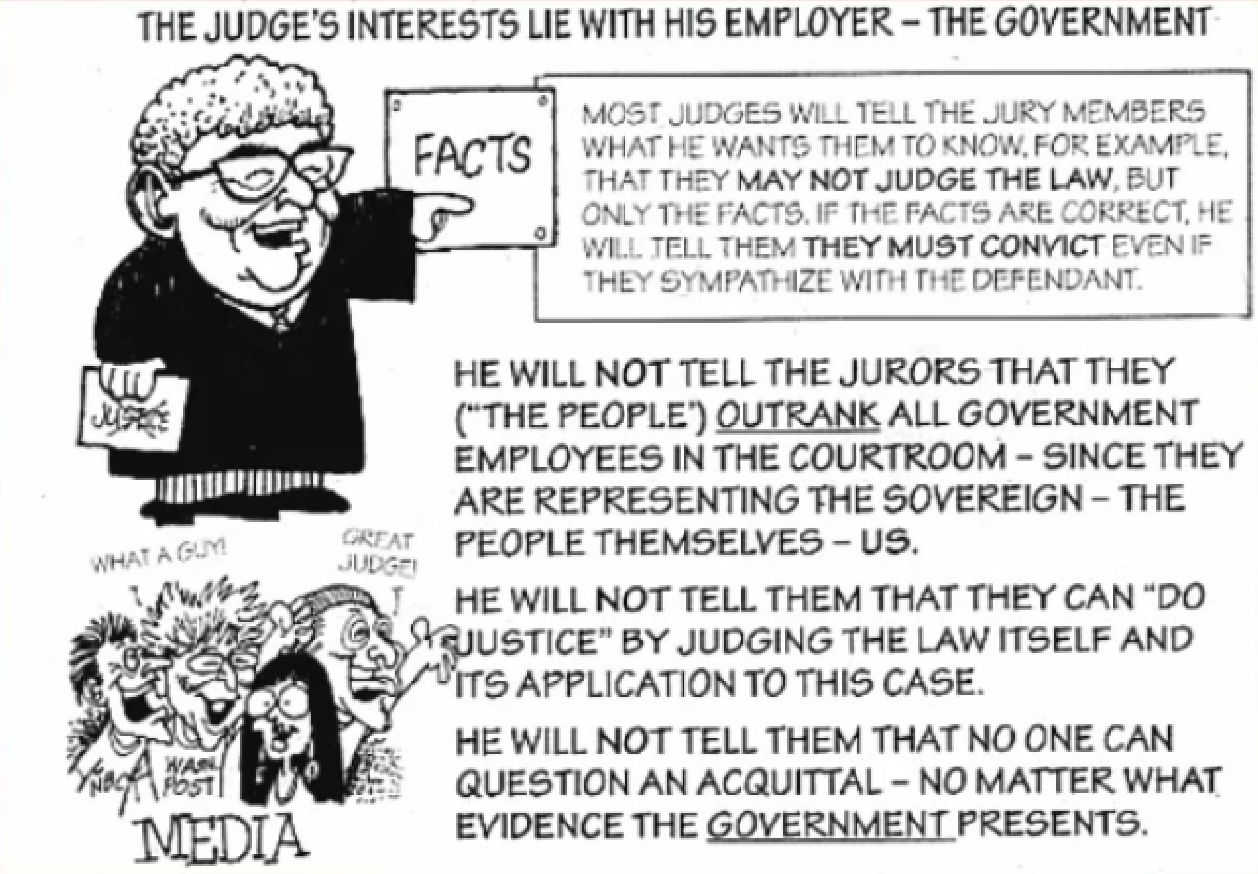
Did you know that, no matter the evidence, if a jury feels a law is unjust, it is permitted to “nullify” the law rather than finding someone guilty? Basically, jury nullification is a jury’s way of saying, “By the letter of the law, the defendant is guilty, but we also disagree with that law, so we vote to not punish the accused.” Ultimately, the verdict serves as an acquittal.
   
By design, defense lawyers are not allowed to even mention jury nullification as a possibility during a trial because judges prefer juries to follow the general protocols rather than delivering independent verdicts.
 

NOT, surprisingly, the Supreme Court has routinely agreed that judges have no obligation to inform juries about jury nullification. Paradoxically, jury nullification is permitted to exist as an option to all juries, yet this option cannot be discussed in most courtrooms.

A few years ago, Julian Heicklen handed out pamphlets to passersby on jury nullification to people outside of a federal courthouse. While the former professor was merely attempting to educate people about how the jury system works, he was charged with jury tampering. The prosecution labeled Heicklen “a significant and important threat to our judicial system,” but the judge ultimately disagreed and dismissed the case. 

The mere fact that this case went to court at all shows how pernicious and evil the legal system truly has become.  After all, here in America you are GUILTY until proven innocent. Unless of course that is you can afford to purchase innocence before hand. 
Jury nullification is hated and feared because of its ability to upset the system's preconceived notion that American citizens are slaves. 

A jury that is aware of the mass inequality in incarceration rates and believes a defendant was targeted via racial profiling can nullify. A jury that believes a harmless defendant is a victim of the prison industrial complex rather than a perpetrator can nullify. This counter-verdict exists so that citizens can right the wrongs inherent in our supposed “justice” system.
Remember, an informed citizen is a FREE citizen.  America was once long ago...

"The Land of the Free and the Home of the Brave..." 

Monday, December 29, 2014

The crack in the US Economy


The dollar's role as the world's reserve currency was first established in 1944 with the Bretton Woods agreement. The U.S. was able assume this role by virtue of it then having the largest gold reserves in the world.

The dollar was pegged at $35 an ounce -- and freely exchangeable into gold at that rate. But by 1971, convertibility into gold was no longer viable as America's gold resources drained away.
Instead, the dollar became a pure fiat currency (decoupled from any physical store of value), until the petrodollar agreement was concluded by President Nixon in 1973.
 
The essence of the deal was that the U.S. would agree to military sales and defense of Saudi Arabia in return for all oil trade being denominated in U.S. dollars.

As a result of this agreement, the dollar then became the only medium in which energy exchange could be transacted.
This underpinned its reserve currency status through the need for foreign governments to hold dollars; recirculated the dollar costs of oil back into the U.S. financial system and -- crucially -- made the dollar effectively convertible into barrels of oil.
The dollar was moved from a gold standard onto a crude oil standard.

U.S. interest rates were then managed so that oil exporters (who formerly looked to gold as the basis of their reserves) would be indifferent to whether they stored their currency reserves, earned from oil exports, in U.S. treasuries, or in gold. The value was equivalent.


The Fed consistently managed Fed funds rates to keep oil prices steady, even when it required mid-teens interest rates and back-to-back recessions in 1980-1982.
Since U.S. Fed funds rates were managed to preserve U.S. creditors' and oil exporters' purchasing power in oil terms, the system proved acceptable to most nations.
While the petrodollar arrangement worked well for nearly 30 years, the arrangement began to wobble around 2002-2004. . .

Oil prices began steadily rising in 2002 and 2003 while Fed funds rates remained low to mitigate the fallout from the 2001 U.S. recession/tech bubble.
As a result, the number of barrels of oil that could be purchased for a face value U.S. Treasury bond declined sharply. . .

After maintaining a range of 55-60 barrels of oil per U.S. Treasury from 1986-1999, a $1,000 face value U.S. Treasury went from buying 60 barrels of oil in 1999 to under 30 by early 2004.
But what may ultimately be seen to have proved fateful to the petrodollar system has been the policy of zero interest rate policy and "quantitative easing" pursued unrestrained since 2008.

Effectively, energy producers saw that the U.S. economy had now become so dependent on low interest rates that it could never again manage to keep oil prices steady relative to U.S. treasuries without blowing up the global financial system.

The U.S. economy had now become too "financialized" to withstand anything more than a token interest rate hike.
The petrodollar system, which had allowed the U.S. dollar to supplant gold as the backing for the oil trade from 1973-2002, was broken.

Energy producers began to accumulate real assets (such as real estate), and returned to purchasing physical gold in lieu of U.S. treasuries.
"The oil producers will effectively import capital amounting to $7.6 billion.

By comparison, they exported $60 billion in 2013 and $248 billion in 2012."

re-post

Friday, December 26, 2014

Why Poke the Russian Bear

For reasons currently unknown to the US public, the lesser, inadequate, baffon in the White house has thought it a good idea to start a quiet war with the Russians.  The drastic drop in oil prices are an economic attack by the United States to disrupt the Russian economy. 

The US is behind the current drop in oil prices as it is aiming to undermine the economies of large petroleum producers Russia and Venezuela, said Bolivian President Evo Morales... 


All the idiot in the White House has done is push the Russian into the arms of the Chinese. 


(Sep 1 2014) Russian President Vladimir Putin and Chinese Vice Premier Zhang Gaoli have launched the construction of the first part of Gazprom’s Power of Siberia pipeline - which will deliver 4 trillion cubic meters of gas to China over 30 years.

“The new gas branch will significantly strengthen the economic cooperation with countries in the Asia-Pacific region and above all - our key partner China,” Putin said at the ceremony outside the city of Yakutsk - the capital of Russia's Republic of Yakutia on Monday.

  While Russia has an intelligence FSB expert at it's helm, the United States has this moron..


The man who rules a third of the earth's surface and has his finger on the button is NOT someone to be taken lightly.  For the idiot in the White House..."It's the one you don't see coming, the one you under estimate who beats you in the end..." 


For those who would like to know who rules Russia with a unseen iron fist I give you..

Vladimir Putin


Putin (POO-teen) was born on October 1, 1952, in Leningrad (now St. Petersburg), Russia. He is an only child. His father, a decorated war veteran, was a foreman in a metal factory. He died in August of 1999, the week his son was appointed prime minister of Russia. Putin's mother, who did not work outside the home, died a year and a half before that. Growing up in Leningrad, Putin lived with his parents in a communal apartment with two other families. Though religion was not permitted in the Soviet Union, his mother secretly had him baptized as an Orthodox Christian. He remains a practicing member of the Church and delivered a Christmas Eve speech in Moscow in 1999.

Though he was a small-built child and is still a short and slim man, Putin could hold his own in fights thanks to martial arts classes. By the age of 16 he was a top-ranked expert at sambo, a Russian combination of judo and wrestling. He attended a prestigious high school, School 281, which only accepted students with near-perfect grades. The institution was the only one in Russia to stress chemistry, which was Putin's interest. However, he soon gravitated toward liberal arts and biology. Putin worked at the school radio station, where he played music by the Beatles and other Western rock bands. Though he attended parties, he was reportedly more mature than others his age, according to one of his fellow students quoted by Michael Wines in the New York Times . Fascinated with spy movies as a teen, he aspired to become a KGB agent.


At Leningrad State University, Putin was the school's judo champion in 1974. He graduated from the law department in 1975. Wines in the New York Times noted that Putin had graduated with honors, but a Newsweek article reported that his thesis adviser, Valery Musin, said he had received "good but not great grades," though he was a "meticulous" student. The Newsweek piece pointed out that his scholastic record had been removed from the university's archives. Later, he received a doctorate in economics as well.


Instead of entering the law field right out of school, Putin landed a job with the KGB, the only one in his class of 100 to be chosen. Though some reports stated that he joined the elite foreign intelligence arm, called the First Chief Directorate, the Newsweek article claimed that his first position was actually in a department called Service Number One in the agency's Leningrad office. This branch was responsible for recruiting foreigners in the country to serve KGB intelligence purposes. Another report by Wines in the New York Times stated that he "was a mid-level KGB agent performing fairly routine duties."


In the early 1980s Putin met and married his wife, Lyudmila, a former teacher of French and English. In 1984 he was selected to attend the prestigious Red Banner Institute of Intelligence, where he mastered German and also learned English in preparation for an international assignment, which he had coveted for some time. In 1985 the KGB sent him to Dresden, East Germany, where he lived undercover as Mr. Adamov, the director of the Soviet-German House of Friendship, a social and cultural club in Leipzig. According to Wines, he spoke so fluently that he could easily mimic regional dialects. Putin appeared to genuinely enjoy socializing with Germans, unlike many other KGB agents, and respected the German trait of discipline.


What Putin did in East Germany has been a matter of some speculation. Wines wrote, "Officially—and perhaps actually—his task was to track the political leanings of East Germans and their contacts with the West." John Lloyd stated in the New York Times Magazine, "His real task was to recruit agents to supply technical and economic information: he may have been involved in setting up a KGB network to prepare for the collapse of East Germany." Insight on the News reporter J. Michael Waller, meanwhile, claimed that Putin oversaw the notorious Stasi secret police force during the 1980s.


Around the time Putin went to East Germany, Soviet leader Mikhail Gorbachev was beginning to introduce economic and social reforms. Putin was apparently a firm believer in the changes. In 1989 the Berlin Wall, separating East from West Germany, was torn down and the two began to unite. Though Putin supposedly had known that this was inevitable, he was disappointed that it occurred amid chaos and that the Soviet leadership had not managed it better.


In 1990 Putin returned to Leningrad and took a job in the international affairs department at his alma mater, screening foreign students. However, that was a cover for his continuing intelligence work. Before long, one of his former university professors, Anatoly Sobchak, who had become the first mayor of St. Petersburg (the former Leningrad), asked him to join his administration. In 1991, just as the Soviet Union was beginning to be unraveled, Putin resigned from the KGB at the rank of colonel, in order to get involved in politics. He allegedly quit because he wanted to be part of the important changes going on in Russia at the time, or perhaps because many of his colleagues in the KGB were persecuted after the fall of the Berlin Wall. In any event, he became the mayor's external affairs aide and, in 1994 became deputy mayor. However, a Newsweek report suggested that he might have been an infiltrator there as well.


During his time in city government, Putin "excelled at unraveling the Goridan knots of Russian bureaucracy and building an infrastructure—highways, telecommunications, hotels—to support foreign investment," according to Wines. Although St. Petersburg never grew to become the financial powerhouse that many had hoped, its fortunes improved as many foreign investors moved in, such as Coca-Cola and Japanese electronics firm NEC. Putin gained the nickname "the gray cardinal" in response to his behind-the-scenes influence and low profile. He was investigated in the early 1990s for allegations of favoritism in granting import and export licenses, but the case was dismissed over lack of evidence.


In 1996, when Sobchak lost his mayoral campaign, Putin was offered a job with the victor, but declined out of loyalty. The next year, he was asked to join President Boris Yeltin's "inner circle" as deputy chief administrator of the Kremlin. He left the Kremlin in 1998 to become head of the Federal Security Service (FSB), the domestic intelligence arm and successor to the KGB, which had been dismantled. In March of 1999, he was named secretary of the Security Council, a body that advises the president on matters pertaining to foreign policy, national security, and military and law enforcement.


In August of 1999, after Yeltsin had gone through five prime ministers in 17 months, he appointed Putin, who was originally dismissed by many observers as not a viable heir apparent to the ill president. For one thing, he had little political experience; for another, his appearance and personality seemed bland. However, Putin increased his appeal among citizens for his role in vehemently pursuing the war in Chechnya. In addition to blaming various bombings in Moscow and elsewhere on Chechen terrorists, he also used harsh rhetoric in condemning his enemies. As Wines reported, this "established his image as a tough and no-nonsense leader at a time when Russians were seeking just such a person." Soon, Putin's popularity ratings were soaring at 50 percent in a nation where an approval rating of even 20 percent is considered a good showing.


In December of 1999, Russia held elections for the 450-seat Duma, the lower house of Russia's parliament. Putin's Unity Party, formed just three months prior, came in a close second to the Communists in a stunning showing. With allies, they were expected to wield just about as much power. Though Putin was not a candidate on the ballot in this election, the candidates rode on his coattails as the obvious front-runner in the upcoming presidential race scheduled for June of 2000.
On New Year's Eve in 1999, Yeltsin unexpectedly stepped down as president, naming Putin as acting president. The election was moved up to March 26 in accordance with the Russian Constitution. Many observers speculated that Yeltsin's move was calculated to ensure Putin's success, just in case public support for the war in Chechnya turned and caused his ratings to fall. It was rumored that Yeltsin also wanted to install Putin in order to escape any prosecution, since Putin had been a loyal follower and Yeltsin had long been accused of corruption and nepotism. Indeed, one of Putin's first actions as acting president was to grant Yeltsin immunity from any future criminal or administrative investigations. The decree also granted continued housing, salary, staffing, and benefits for Yeltsin and his family.


Immediately, Western news media and the United States government scrambled to create a profile of the new Russian leader. Due to Putin's secretive background as a KGB agent, information was scarce. Many articles focused on the fact that, despite his popularity, few even in his own nation knew details of his background or where he stood on issues. His history as a spy caused many Westerners and some Russians as well to question whether he should be feared as a foe of democracy. In addition, Christian Caryl wrote in U.S. News and World Report, "Putin's watch at the FSB (from July 1998 until August 1999) coincided, in part, with a series of high-profile prosecutions of environmental activists accused of 'betraying state secrets' (actually publicizing the lackadaisical disposal of dangerous nuclear waste by the Russian military)."


In Putin's first speech as acting president, he promised, "Freedom of speech, freedom of conscience, freedom of the press, the right to private property these basic principles of a civilized society will be protected," according to a Newsweek report. In addition, Putin rid his cabinet of several of Yeltsin's cronies and relatives, including Yeltsin's daughter, who served as his chief adviser. However, an Economist article dismissed the changes as "cosmetic," saying, "other Kremlin insiders remain firmly in place." In addition, Putin raised eyebrows when, a couple of weeks later, he made a power-sharing pact with Communists in the Duma that effectively shut out most free-market democrats. Still, his popularity among Russians hovered at 50 percent or higher in the weeks leading up to the election.
On March 26, 2000, Russians elected Putin out of a field of 11 candidates, including Communist leader Gennady Zyuganov, who won 42 percent of the vote in a tight race in 1996 against Yeltsin. Putin won with 52.6 percent of the vote as compared to runner-up Zyuganov, who gathered 29.3 percent. After his election, Putin's first legislative initiative, in April of 2000, was to win approval of the Start II arms reduction treaty from the Duma. The deal, which was negotiated seven years earlier, involved decreasing both the Russian and American nuclear buildup by half. Putin's move on this issue was seen as both a positive step in his willingness to develop a positive relationship with the United States but also as a sign that he would resist American efforts on antimissile defenses. In addition to forging talks with the United States, one of Putin's earliest moves involved working with a team of economists to try to develop a plan to improve the country's economy. On May 7, 2000, Putin was officially sworn in as Russia's second president and its first in a free transfer of power in the nation's 1,100-year history.


Putin, a soft-spoken and stone-faced man, keeps his personal life very private. He and his wife have two daughters, Katya and Maria, who were both in their early teens when he became president. Putin has a black belt in judo and enjoys running. He does not smoke, and does not drink alcohol, or at least drinks so rarely that it appears that way.

Sunday, December 14, 2014

The Coming National Police Militarization Force


Department of Defense Excess Property Program (DoD 1033)

The Department of Defense Excess Property Program (1033 Program) is authorized under federal law and managed through the Defense Logistics Agency's Law Enforcement Support Office (LESO) in Ft. Belvoir, Va. 

The 1033 Program provides surplus DoD military equipment to state and local civilian law enforcement agencies for use in counter-narcotics and counter-terrorism operations, and to enhance officer safety. The Missouri Department of Public Safety is the sponsoring state agency responsible for administration of the 1033 Program in Missouri.
DoD 1033 Application to Participate (revised 9/2/14)
Complete and submit the following forms if requesting weapons:
DoD 1033 Items
A small sample of the types of items issued in the past to participating agencies are aircraft (both fixed wing and rotary) and four-wheel drive vehicles (such as pickup trucks, blazers, ambulances and armored personnel carriers). The ambulances are used for mobile command vehicles and search warrant entry teams. The armored personnel carriers are used for S.W.A.T. teams along with victim an officer recovery. Ballistic helmets and vests are issued for officer safety. BDU clothing (including Nomex fire retardant), boots, wet weather and cold weather clothing, canteens, and web belts are some of the types of field gear items issued for marijuana eradication. Binoculars, radios, camcorders, and tv/vcr combinations are used for tactical and intelligence gathering operations. Information technology equipment such as desktop and laptop computers, printers, and servers have also been issued.

Eligible Applicants
 Any state or local law enforcement agency may participate in the DoD program.


Application Process
 The Chief or Sheriff of the agency must complete and sign an application. Once this application has been approved, the Department of Defense Law Enforcement Support Office will issue a screening authorization letter to the local Drug Law Enforcement Agency (DLEA) to screen excess property via the Defense Reutilization Marketing Services internet site where the DRMO's post their inventory. When an agency receives property through the 1033 Program, the Chief or Sheriff will be held accountable for the inventory and see the property obtained through this program is used within the guidelines of the program. Random site visits may be made by the Department of Public Safety to ensure proper use and inventory of property received. 

Application Information
Applications are available by request from the Missouri Department of Public Safety or by clicking the application link above. The application includes a Memorandum of Agreement (MOA) that must be sign by the Chief or Sheriff. A copy of this MOA must be kept on file with the participating agency. All items requested must be justified for use in a bona fide law enforcement mission or field activity.